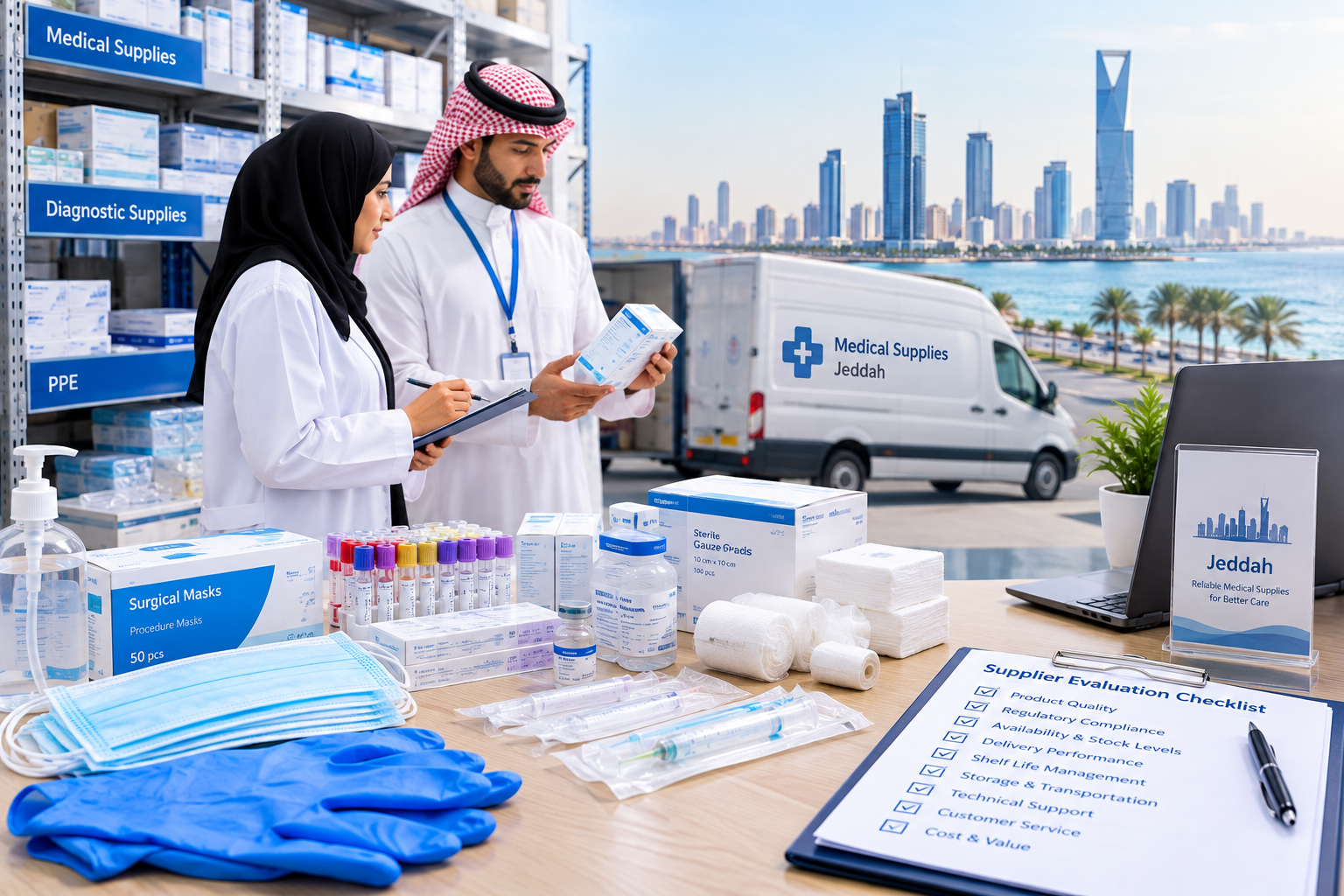
Medical supplies in Jeddah are essential to the daily operations of hospitals, clinics, diagnostic centers, pharmacies, and other healthcare facilities. From basic consumables and infection control products to diagnostic supplies and medical devices, healthcare providers depend on a reliable supply chain to maintain continuity of care and operational readiness.
Jeddah is an important healthcare center in Saudi Arabia, with healthcare facilities requiring a wide range of products and services to support different medical specialties. Recent Ministry of Health activity in Jeddah has highlighted the importance of facility readiness, quality, patient safety, and efficient healthcare operations.
For hospitals and clinics, choosing a local medical supplies supplier is therefore about more than finding competitive prices. The right supplier should be able to provide appropriate products, reliable delivery, regulatory compliance, responsive service, and consistent supply.
Why Does Choosing the Right Medical Supplier Matter?
Healthcare facilities cannot always afford delays in receiving essential supplies. A shortage of a commonly used consumable can disrupt routine procedures, while a delayed medical device or specialized product may affect scheduling and operational planning.
A reliable supplier can help healthcare facilities:
- Maintain adequate inventory levels.
- Reduce the risk of stockouts.
- Improve procurement planning.
- Receive products within expected delivery times.
- Access appropriate medical products and equipment.
- Manage urgent supply requirements.
- Maintain better inventory visibility.
- Support continuity of patient care.
The objective should not simply be to find the cheapest supplier, but to establish a supply relationship that supports the facility’s operational and clinical requirements.
What Should Hospitals and Clinics Look for in a Jeddah Medical Supplies Supplier?
Different healthcare facilities have different procurement requirements. However, several factors should be considered when evaluating a local supplier.
1. Product Range and Availability
A supplier should be able to provide the categories of products that the facility uses regularly.
These may include:
- Medical consumables.
- Wound care supplies.
- Infection control products.
- Personal protective equipment.
- Laboratory supplies.
- Diagnostic products.
- Syringes and needles.
- IV administration supplies.
- Patient care products.
- Medical equipment and devices.
- Cleaning and disinfection products.
A broad product portfolio can simplify procurement by reducing the need to coordinate with multiple suppliers.
However, product range alone is not enough. Facilities should also evaluate actual product availability and the supplier’s ability to maintain consistent stock levels.
2. Regulatory Compliance
Regulatory compliance should be one of the first considerations when choosing a supplier of medical devices and supplies in Saudi Arabia.
The Saudi Food and Drug Authority (SFDA) requires establishments conducting activities covered by the Medical Devices and Supplies Law to be registered and licensed. The SFDA also provides specific licensing requirements for medical device establishments, including importers and distributors.
Healthcare facilities should therefore verify the supplier’s relevant licensing status and ensure that products are appropriately authorized for the Saudi market where applicable.
The SFDA also maintains a searchable list of licensed establishments, which can be used as part of supplier verification.
3. Product Quality and Documentation
Healthcare facilities should have confidence in the quality and traceability of the products they purchase.
Depending on the product category, procurement teams may need to review:
- Product specifications.
- Manufacturer information.
- Regulatory documentation.
- Product registration or marketing authorization where applicable.
- Certificates and quality documentation.
- Lot or batch information.
- Expiry dates.
- Instructions for use.
Good documentation makes it easier for healthcare facilities to verify products and maintain appropriate internal records.
4. Delivery Speed and Local Availability
One of the advantages of working with a supplier in Jeddah is the potential for shorter delivery times and easier communication.
Local suppliers may be able to support facilities with:
- Regular scheduled deliveries.
- Faster replenishment.
- Urgent orders.
- Local delivery coordination.
- Easier communication with procurement teams.
- Better understanding of local operational requirements.
However, being located in the same city does not automatically guarantee reliable service. Hospitals and clinics should evaluate actual delivery performance rather than relying solely on geographic proximity.
5. Inventory and Stock Management Support
A strong supplier should understand that healthcare procurement involves more than placing an order and receiving a shipment.
Facilities may benefit from suppliers that can support:
- Regular stock replenishment.
- Forecast-based purchasing.
- Minimum and maximum stock levels.
- Expiry-date management.
- Product availability monitoring.
- Emergency requirements.
- Recurring supply schedules.
This can be particularly valuable for products with high consumption rates or critical operational importance.
6. Product Shelf Life and Expiry Management
Healthcare facilities should pay attention to the remaining shelf life of products when receiving medical supplies.
This is particularly important for:
- Laboratory reagents.
- Sterile medical supplies.
- Disinfectants.
- Diagnostic products.
- Certain wound care products.
- Other products with limited shelf life.
A supplier should have appropriate inventory rotation practices and should provide products with a shelf life that is reasonable for the facility’s expected consumption.
This helps reduce waste and prevents healthcare facilities from receiving products that may expire before they can be used.
7. Storage and Transportation Conditions
Some medical supplies require specific environmental conditions during storage and transportation.
Depending on the product, these may include requirements related to:
- Temperature.
- Humidity.
- Protection from light.
- Packaging integrity.
- Clean transportation conditions.
- Handling procedures.
Facilities should ask suppliers how products are stored and transported, particularly when purchasing temperature-sensitive or otherwise sensitive medical products.
Appropriate handling is important because product quality can be affected if storage or transportation conditions are not maintained.
8. Technical Support and After-Sales Service
For medical devices and equipment, procurement does not necessarily end when the product is delivered.
Healthcare facilities may need:
- Installation support.
- User training.
- Technical assistance.
- Preventive maintenance.
- Repairs.
- Replacement parts.
- Warranty support.
The SFDA’s requirements for safe use of medical devices inside healthcare facilities reinforce the importance of appropriate processes surrounding medical device use and safety.
For this reason, hospitals and clinics should evaluate the supplier’s ability to provide ongoing technical support when selecting medical equipment and devices.
9. Ability to Handle Urgent Orders
Healthcare operations do not always follow predictable purchasing schedules. Unexpected increases in patient volume, equipment problems, or sudden shortages may create urgent procurement requirements.
Before selecting a supplier, facilities should understand:
- Whether urgent orders are accepted.
- Available delivery options.
- Response times.
- Communication channels.
- Availability of critical products.
- Procedures for emergency requests.
A clearly defined process can reduce uncertainty when urgent supplies are required.
10. Communication and Customer Service
Communication can have a major impact on the procurement process.
A reliable supplier should provide clear communication regarding:
- Product availability.
- Prices and quotations.
- Expected delivery dates.
- Backordered products.
- Product substitutions.
- Changes in availability.
- Documentation.
- Complaints or product issues.
Consistent communication allows procurement teams to make decisions earlier instead of discovering supply problems after an order has already been placed.
How Can Hospitals Compare Medical Suppliers?
Healthcare facilities can create a standardized supplier evaluation process instead of choosing suppliers based only on price.
A comparison may consider:
| Factor | What to Evaluate |
|---|---|
| Product range | Availability of required product categories |
| Quality | Product specifications and consistency |
| Compliance | Licensing and applicable regulatory requirements |
| Availability | Stock levels and continuity |
| Delivery | Speed and reliability |
| Shelf life | Remaining expiry period |
| Storage | Appropriate handling and transportation |
| Technical support | Installation, maintenance, and assistance |
| Customer service | Communication and responsiveness |
| Pricing | Overall procurement cost |
| Emergency support | Ability to handle urgent requirements |
This approach gives procurement teams a more complete picture of supplier performance.
Questions to Ask Before Choosing a Local Supplier
Before starting a long-term supply relationship, hospitals and clinics can ask potential suppliers:
- Are you appropriately licensed for the activities you perform?
- Which product categories do you supply?
- What is your typical delivery lead time in Jeddah?
- Do you maintain local inventory?
- How do you manage product expiry dates?
- What are your storage and transportation procedures?
- Can you support urgent orders?
- Do you provide technical support for medical devices?
- What documentation is available for supplied products?
- How do you handle product complaints or returns?
- Can you provide recurring supply arrangements?
Clear answers to these questions can help procurement teams identify suppliers that are better aligned with their operational requirements.
Why Local Supply Relationships Can Add Value
A local supplier can provide more than geographic convenience. When the supplier understands the local healthcare environment and develops an ongoing relationship with the facility, procurement can become more predictable.
Long-term collaboration can support:
- Better demand forecasting.
- More consistent availability.
- Faster communication.
- Easier delivery coordination.
- Improved understanding of facility requirements.
- More efficient recurring orders.
- Better response to urgent needs.
However, local presence should be considered alongside quality, compliance, availability, and service performance.
Building a Long-Term Medical Supply Strategy
Healthcare facilities should avoid relying entirely on reactive purchasing. Instead, procurement teams can use historical consumption data and operational requirements to build a more structured supply strategy.
This may include:
- Identifying critical products.
- Monitoring consumption trends.
- Establishing reorder points.
- Maintaining appropriate safety stock.
- Reviewing supplier performance.
- Monitoring expiry dates.
- Evaluating delivery reliability.
- Maintaining alternative suppliers for selected critical products.
- Reviewing procurement costs regularly.
A structured strategy can help facilities reduce both stockouts and unnecessary inventory.
Medical Supplies Supplier Checklist for Hospitals and Clinics
Before selecting a local supplier in Jeddah, healthcare facilities can use the following checklist:
- Verify the supplier’s relevant licensing.
- Review the available product range.
- Confirm product quality and documentation.
- Check product availability.
- Evaluate delivery times.
- Review shelf-life practices.
- Ask about storage and transportation conditions.
- Evaluate technical support.
- Confirm warranty and maintenance arrangements where applicable.
- Ask about urgent orders.
- Review customer service and communication.
- Compare overall procurement costs.
- Monitor supplier performance after selection.
Supplier evaluation should be an ongoing process rather than a one-time decision.
Conclusion
Choosing a reliable supplier for medical supplies in Jeddah is an important part of maintaining efficient healthcare operations. Hospitals and clinics need more than competitive prices; they need suppliers that can provide consistent availability, appropriate quality, regulatory compliance, reliable delivery, and responsive support.
A strong supplier selection process should consider product range, licensing, documentation, stock availability, expiry management, storage and transportation, technical support, emergency service, and communication.
The SFDA provides licensing frameworks and searchable information on licensed medical device establishments, giving healthcare facilities an important starting point for supplier verification.
By evaluating suppliers using clear criteria and monitoring their performance over time, healthcare facilities can build stronger procurement relationships, reduce supply disruptions, and maintain the products needed to support safe and efficient patient care.
The goal is not simply to find a supplier in Jeddah, but to establish a reliable medical supply partnership that supports quality, continuity, compliance, and readiness.